
Business Aviation
London City Airport Debuts E195-E2: Capacity Meets Sustainability
LCY welcomes Helvetic’s Embraer E195-E2 jet with 30% lower emissions and advanced noise reduction, enabling expanded routes while maintaining operational limits.


London City Airport’s New Aviation Milestone
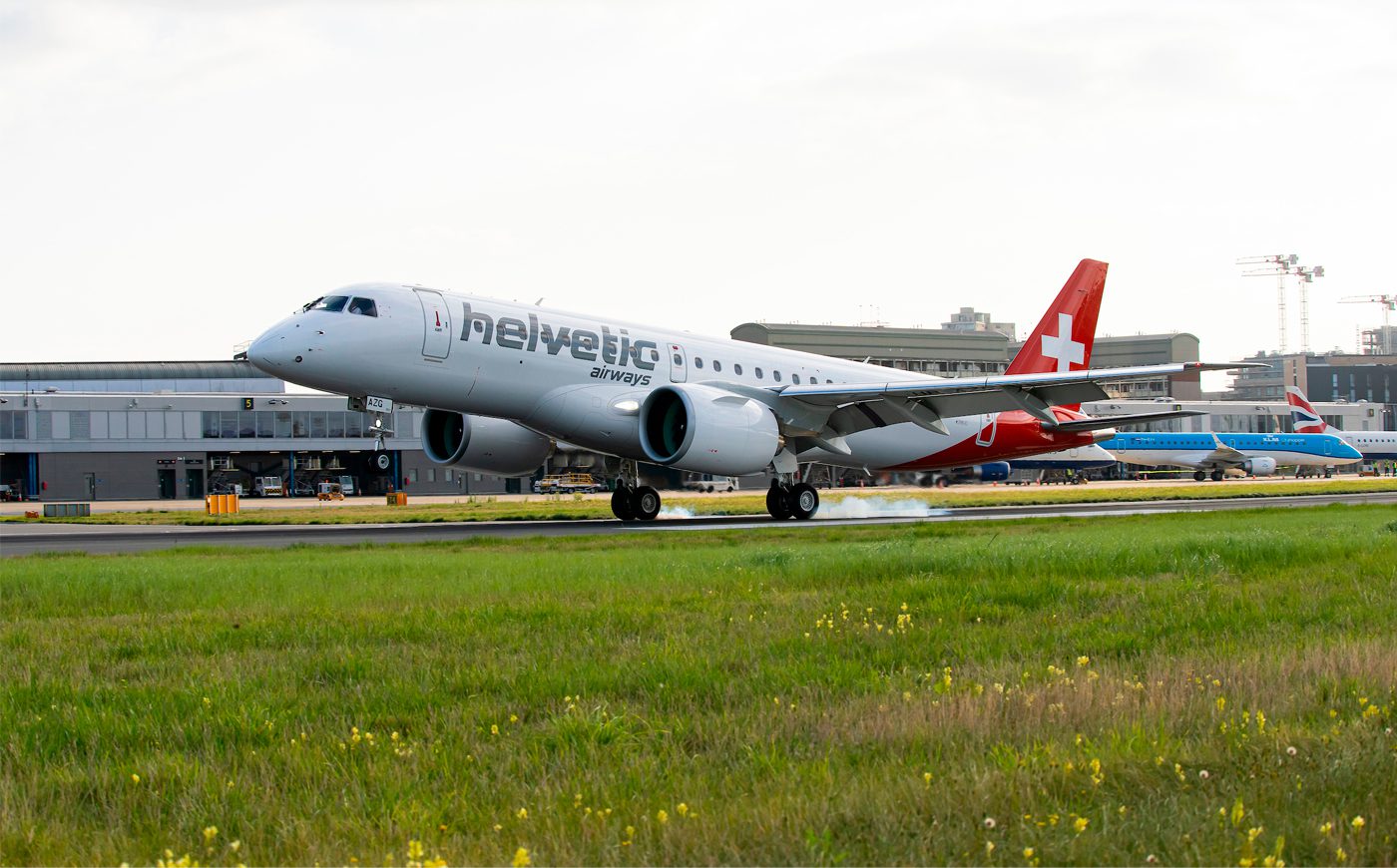
London City Airport (LCY) has entered a new era of operations with the historic landing of Helvetic Airways’ Embraer E195-E2. This 134-seat jet now holds the title of largest commercial aircraft serving the Docklands-based airport, surpassing previous operational limits set by LCY’s unique 5.5° glide path and 1,500m runway. The March 2025 debut flight from Zurich marks a strategic shift for an airport that primarily serves business travelers with smaller regional jets.
The achievement represents more than just size – it demonstrates evolving aviation technology meeting stringent environmental and operational requirements. With 30% lower CO2 emissions per seat and 63% reduced noise footprint compared to previous generation aircraft, the E195-E2 aligns with LCY’s sustainability goals while expanding passenger capacity without increasing flight movements.
Technical Breakthroughs Enabling LCY Operations
The E195-E2’s certification for LCY operations required solving multiple engineering challenges. Its Enhanced Approach and Landing Automation System handles the airport’s steep 5.5° approach (nearly double the standard 3° glide path). The aircraft’s 41.5m length demanded precision braking systems to stop within the short runway, achieved through carbon brakes absorbing 30% more energy than previous models.
Embraer’s upcoming E2TS takeoff optimization system promises further improvements. When certified, this technology will increase the E195-E2’s range from LCY by 25% (3,200km to 4,000km), potentially enabling routes to Athens, Cairo, and Gran Canaria. Current performance already allows 3-hour flights to 90% of European business hubs.
“The E195-E2’s noise reduction alone is game-changing – equivalent to removing 27,000 cars from London’s roads annually,” notes Embraer’s Marie-Louise Philippe.
Operational and Economic Impacts
Helvetic’s wet-lease operation for SWISS International Air Lines demonstrates LCY’s growing appeal for full-service carriers. The E195-E2’s 134 seats (20% more than LCY’s previous largest E190-E2) enable better economics on premium routes – crucial when LCY’s passenger cap stands at 6.5 million annually.
Airport CEO Alison FitzGerald emphasizes this growth strategy: “Each E195-E2 flight carries 34 more passengers than previous jets, helping maximize our capacity without breaching movement limits.” The aircraft’s 2,800kg/hour fuel burn translates to 18% lower operating costs per seat, making marginal routes economically viable.
Future Expansion and Challenges
LCY’s push for A320neo operations (156 seats) faces technical hurdles. While Airbus narrowbodies offer 16% more capacity, their 37m wingspan versus E195-E2’s 28.7m requires revised taxiway clearances. The airport’s 2024 masterplan includes £25 million in infrastructure upgrades to accommodate larger aircraft.
Environmental groups remain cautious. Clean Air London estimates the E195-E2’s NOx emissions at 12% below previous jets, but total emissions could rise with increased passenger numbers. Airport officials counter that new Sustainable Aviation Fuel (SAF) partnerships aim for 10% SAF usage by 2028.
Conclusion
The E195-E2’s LCY debut represents a balancing act between operational constraints and aviation progress. By leveraging next-gen aircraft capabilities, the airport enhances its position as Europe’s premier business aviation hub while addressing environmental concerns through technological innovation.
Looking ahead, LCY’s evolution will test the aviation industry’s ability to reconcile growth with sustainability. As Embraer and Airbus compete for the airport’s future fleets, the real winners may be travelers gaining premium connectivity from central London to an expanding network of European and North African destinations.
FAQ
Why can’t regular jets land at London City Airport?
The combination of steep 5.5° approach angle, short runway, and urban location requires specialized aircraft certification and pilot training.
How does the E195-E2’s range compare from LCY?
Current 3,200km range covers Western Europe, expanding to 4,000km with upcoming takeoff system enhancements.
Will larger aircraft increase flight noise?
Despite more seats, the E195-E2’s noise footprint is 63% smaller than previous generation aircraft through improved engines and approach procedures.
Sources:
London City Airport,
Aerospace Global News,
Aviation24



Business Aviation
Apollo and KKR Value Atlantic Aviation at Nearly $10 Billion
Apollo and KKR announced a strategic partnership valuing FBO network Atlantic Aviation at nearly $10 billion in August 2026.

Apollo Global Management and KKR & Co. Inc. announced a strategic partnership on August 27, 2026, valuing fixed-base operator (FBO) network Atlantic Aviation at nearly $10 billion. The transaction sees Apollo-managed funds acquire a significant stake in the company, while KKR retains a substantial shareholder position.
In a joint press release, the investment firms outlined plans to support the continued expansion of Atlantic Aviation, which provides mission-critical infrastructure such as aircraft fueling and hangar leasing across the United States. The $10 billion valuation represents a sharp increase from the $4.5 billion KKR paid to acquire the company from Macquarie Infrastructure in 2021, reflecting sustained demand for private aviation facilities.
Strategic Investment and Market Positioning
Investments: Apollo has originated $155 billion in infrastructure transactions across various sectors over the past five years. KKR brings extensive sector experience, having invested $12 billion across the aviation industry since 2015 and currently managing $120 billion in infrastructure assets.
David Cohen, a partner at Apollo Global Management, highlighted the company’s irreplicable infrastructure footprint across busy Airports, which is supported by long-term concession agreements.
“The private aviation market has structural tailwinds that we believe will persist, and Atlantic is well positioned to capture that growth. We look forward to working closely with Jeff, the entire Atlantic team and KKR to build on its momentum through targeted investment and strategic new market expansion.”
Dash Lane, a partner at KKR & Co. Inc., noted that the continued support reflects conviction in the platform and the long-term growth of the sector. Lane stated that the firm has worked closely with the Atlantic Aviation team over the past five years to expand and strengthen the business.
Operational Impact for Atlantic Aviation
Atlantic Aviation CEO Jeff Foland characterized the investment as a validation of the company’s performance and potential.
“This transaction is more than a milestone for Atlantic, it is a powerful validation of what our people have built together. To have two of the world’s most respected investment firms choose to invest in our company is an extraordinary endorsement of our people, our performance, and our potential.”
The exact financial terms, including the specific purchase price paid by Apollo and the resulting ownership split between the two firms, were not disclosed in the announcement.
AirPro News analysis
We view the doubling of Atlantic Aviation’s valuation over a five-year period as a clear indicator of the premium placed on established FBO networks. The private aviation sector has experienced sustained structural growth, compounded by broader commercial aircraft shortages and an overall increase in private flight activity. Because airport real estate is finite and long-term concession agreements create high barriers to entry, incumbent FBO operators hold significant pricing power. The combined financial backing of Apollo and KKR will likely accelerate Atlantic Aviation’s acquisition of independent FBOs and expansion into new regional markets.
Sources: Apollo Global Management
Photo Credit: Atlantic Aviation
Business Aviation
Atlantic Aviation Breaks Ground on New FBO at Nashville JWN
Atlantic Aviation begins construction of a new executive FBO terminal and hangar at John C. Tune Airport, due Q4 2027.

Atlantic Aviation has officially commenced construction on a new executive fixed-base operator (FBO) terminal and hangar complex at John C. Tune Airports (JWN) in Nashville, Tennessee, expanding its infrastructure footprint in the region.
Announced in a press release on August 25, 2026, the project is slated for completion in the fourth quarter of 2027. The development follows Atlantic Aviation’s successful bid for a new leasehold through a Metropolitan Nashville Airport Authority (MNAA) request for proposals in May 2025 and complements the company’s existing operations at Nashville International Airport (BNA).
Facility specifications and infrastructure
The planned facility will feature a 7,500-square-foot executive terminal alongside a 37,000-square-foot hangar and office complex. To accommodate aircraft movement and parking, the project includes the development of approximately 175,000 square feet of new ramp space.
The infrastructure upgrades will incorporate a new fuel farm with a 60,000-gallon capacity for Jet-A and a 12,000-gallon capacity for 100LL aviation gasoline. According to the company, the design integrates Sustainability initiatives, including Leadership in Energy and Environmental Design (LEED) focused elements, efficient building systems, and construction waste minimization strategies.
Strategic expansion in the Nashville market
Located eight miles west of downtown Nashville, John C. Tune Airport serves as a primary reliever for BNA and a key gateway for general aviation. MNAA President and Chief Executive Officer Doug Kreulen stated that the expansion marks a major step forward in strengthening access for the area’s growing general aviation community.
“By bringing world-class facilities and services to John C. Tune Airport, Atlantic Aviation is helping us position the airport for long-term success, and we’re excited for the expanded opportunities this Investments will create for our customers and for Middle Tennessee,” Kreulen said.
Atlantic Aviation Chief Executive Officer Jeff Foland described the start of construction as an exciting milestone for the Partnerships. The company previously opened a newly completed FBO facility at BNA in June 2024.
AirPro News analysis
We view Atlantic Aviation’s dual-airport Strategy in Nashville as a direct response to the region’s sustained economic and population growth. By establishing a modern presence at JWN just two years after securing the leasehold, the company is positioning itself to capture overflow corporate traffic that might otherwise face congestion at BNA. The inclusion of substantial ramp space and high-capacity fuel storage indicates an expectation of high-volume, large-cabin business jet traffic at the reliever airport.
Sources: Atlantic Aviation
Photo Credit: Atlantic Aviation
Business Aviation
Avcon Industries Delivers Modified King Air B200 for Mosquito Control
Avcon Industries delivered a modified Beechcraft King Air B200 to Lee County Mosquito Control District in Florida for aerial pest mitigation.

Avcon Industries, Inc. delivered its first specially modified Beechcraft King Air B200 equipped for large-scale mosquito mitigation to the Lee County Mosquito Control District in Florida on August 25, 2026.
In a press release, the Butler National Corporation subsidiary detailed the engineering modifications designed to support rapid airborne liquid dispersal for disease and pest prevention. The delivery provides the Florida district with a twin-engine turboprop platform capable of covering larger areas than traditional ground-based methods or smaller agricultural aircraft.
Engineering and modification details
The special mission modification centers on a removable external under-fuselage pod. The system incorporates an electric pump, aerodynamic fairings, and dispersal booms to facilitate repeatable fluid application.
Avcon Industries President Marcus Abendroth stated the project highlights the company’s capacity to integrate specialized mission systems into established airframes.
“The King Air B200 provides an excellent platform for this mission, and the solution developed by our team creates an opportunity to support similar mosquito-control and airborne dispersal requirements for other operators,” Abendroth said.
Operational impact in Florida
Mosquito mitigation remains a persistent public health requirement in Florida due to the climate and the associated risk of mosquito-borne illnesses. The Lee County Mosquito Control District utilizes aviation assets to manage these risks across extensive geographical areas.
Wayne Luettich, Aircraft Maintenance Manager for the district, emphasized the importance of the new platform for local residents.
“Mosquito control has become a significant effort in Florida. We have an important mission to mitigate the impact of the mosquitoes on our residents. We look forward to operating the Avcon-modified airplane and appreciate the Avcon engineering services,” Luettich said.
AirPro News analysis
We note that adapting business aviation platforms like the King Air B200 for public health missions reflects a demand for higher payload and extended range in aerial application. While single-engine agricultural aircraft excel in localized operations, twin-engine turboprops offer the speed and capacity required for county-wide vector control, particularly in coastal regions requiring rapid response to emerging public health threats.
Sources: Avcon Industries, Inc.
Photo Credit: Avcon Industries
-

 Technology & Innovation6 days ago
Skyband Systems M100 LRU Validates GNSS Jamming Protection
-

 MRO & Manufacturing5 days ago
Boeing SPEEA Engineers Reject Contract, Authorize Strike
-

 Military Technology6 days ago
Saab Unveils A3-001 Supersonic Stealth Drone Concept
-

 Business Aviation5 days ago
FTAI Aviation Closes $2B Warehouse Financing for 2026 SPV
-

 Business Aviation6 days ago
SyberJet SJ30-2 Sets Transcontinental Speed Record