
Business Aviation
London City Airport Debuts E195-E2: Capacity Meets Sustainability
LCY welcomes Helvetic’s Embraer E195-E2 jet with 30% lower emissions and advanced noise reduction, enabling expanded routes while maintaining operational limits.


London City Airport’s New Aviation Milestone
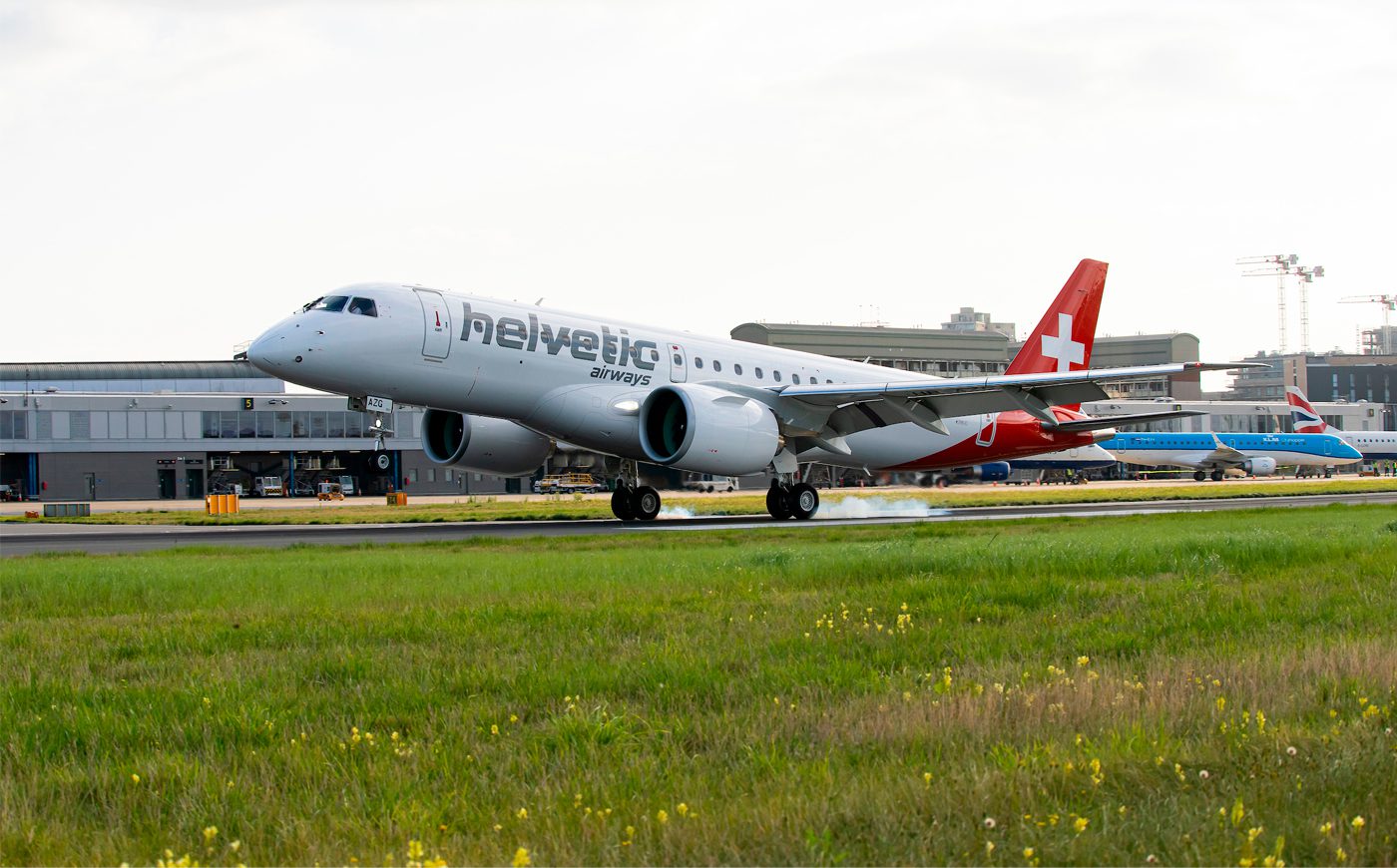
London City Airport (LCY) has entered a new era of operations with the historic landing of Helvetic Airways’ Embraer E195-E2. This 134-seat jet now holds the title of largest commercial aircraft serving the Docklands-based airport, surpassing previous operational limits set by LCY’s unique 5.5° glide path and 1,500m runway. The March 2025 debut flight from Zurich marks a strategic shift for an airport that primarily serves business travelers with smaller regional jets.
The achievement represents more than just size – it demonstrates evolving aviation technology meeting stringent environmental and operational requirements. With 30% lower CO2 emissions per seat and 63% reduced noise footprint compared to previous generation aircraft, the E195-E2 aligns with LCY’s sustainability goals while expanding passenger capacity without increasing flight movements.
Technical Breakthroughs Enabling LCY Operations
The E195-E2’s certification for LCY operations required solving multiple engineering challenges. Its Enhanced Approach and Landing Automation System handles the airport’s steep 5.5° approach (nearly double the standard 3° glide path). The aircraft’s 41.5m length demanded precision braking systems to stop within the short runway, achieved through carbon brakes absorbing 30% more energy than previous models.
Embraer’s upcoming E2TS takeoff optimization system promises further improvements. When certified, this technology will increase the E195-E2’s range from LCY by 25% (3,200km to 4,000km), potentially enabling routes to Athens, Cairo, and Gran Canaria. Current performance already allows 3-hour flights to 90% of European business hubs.
“The E195-E2’s noise reduction alone is game-changing – equivalent to removing 27,000 cars from London’s roads annually,” notes Embraer’s Marie-Louise Philippe.
Operational and Economic Impacts
Helvetic’s wet-lease operation for SWISS International Air Lines demonstrates LCY’s growing appeal for full-service carriers. The E195-E2’s 134 seats (20% more than LCY’s previous largest E190-E2) enable better economics on premium routes – crucial when LCY’s passenger cap stands at 6.5 million annually.
Airport CEO Alison FitzGerald emphasizes this growth strategy: “Each E195-E2 flight carries 34 more passengers than previous jets, helping maximize our capacity without breaching movement limits.” The aircraft’s 2,800kg/hour fuel burn translates to 18% lower operating costs per seat, making marginal routes economically viable.
Future Expansion and Challenges
LCY’s push for A320neo operations (156 seats) faces technical hurdles. While Airbus narrowbodies offer 16% more capacity, their 37m wingspan versus E195-E2’s 28.7m requires revised taxiway clearances. The airport’s 2024 masterplan includes £25 million in infrastructure upgrades to accommodate larger aircraft.
Environmental groups remain cautious. Clean Air London estimates the E195-E2’s NOx emissions at 12% below previous jets, but total emissions could rise with increased passenger numbers. Airport officials counter that new Sustainable Aviation Fuel (SAF) partnerships aim for 10% SAF usage by 2028.
Conclusion
The E195-E2’s LCY debut represents a balancing act between operational constraints and aviation progress. By leveraging next-gen aircraft capabilities, the airport enhances its position as Europe’s premier business aviation hub while addressing environmental concerns through technological innovation.
Looking ahead, LCY’s evolution will test the aviation industry’s ability to reconcile growth with sustainability. As Embraer and Airbus compete for the airport’s future fleets, the real winners may be travelers gaining premium connectivity from central London to an expanding network of European and North African destinations.
FAQ
Why can’t regular jets land at London City Airport?
The combination of steep 5.5° approach angle, short runway, and urban location requires specialized aircraft certification and pilot training.
How does the E195-E2’s range compare from LCY?
Current 3,200km range covers Western Europe, expanding to 4,000km with upcoming takeoff system enhancements.
Will larger aircraft increase flight noise?
Despite more seats, the E195-E2’s noise footprint is 63% smaller than previous generation aircraft through improved engines and approach procedures.
Sources:
London City Airport,
Aerospace Global News,
Aviation24



Business Aviation
Pilatus PC-24 Adds Gogo Galileo LEO Broadband Connectivity
Pilatus Aircraft offers Gogo Galileo LEO internet on the PC-24 with FAA and EASA certification for new builds and retrofits.

Pilatus Aircraft has introduced Gogo Galileo high-speed internet as a factory-installed option for the Pilatus PC-24, bringing low-latency broadband connectivity to the light jet platform.
In a press release issued on July 1, 2026, the manufacturers confirmed the integration utilizes the Eutelsat OneWeb Low Earth Orbit (LEO) satellite network to provide global coverage capable of supporting video conferencing, media streaming, and cloud-based services. The system has received certification from both the Federal Aviation Administration (FAA) and the European Union Aviation Safety Agency (EASA), making it available for new production aircraft as well as retrofits for the in-service fleet.
Lufthansa Technik entertainment integration and cabin upgrades
Alongside the connectivity upgrade, Pilatus detailed a new integrated cabin management and entertainment system developed in partnership with Lufthansa Technik. The system features a 10-inch touchscreen display that allows passengers to control cabin functions and access media directly from their seats.
The audio experience has also been upgraded as part of the new package. The configuration includes four cabin loudspeakers paired with a subwoofer. To maximize cabin comfort and flexibility, Pilatus introduced a side-facing divan option measuring nearly 2 meters in length, expanding the seating and resting configurations available to PC-24 operators.
Expanding LEO connectivity across the Pilatus fleet
The PC-24 announcement follows recent connectivity advancements for the manufacturer’s turboprop line. On June 16, 2026, SD Government and Pro Star Aviation secured an FAA Supplemental Type Certificate (STC) for the installation of the Gogo Galileo HDX system on the Pilatus PC-12.
This earlier approval marked the first LEO satellite connectivity option for the single-engine PC-12. The sequential rollout indicates a broader push to equip the Pilatus product line with modern, high-speed satellite internet capabilities regardless of aircraft class.
AirPro News analysis
We view the integration of LEO satellite networks like Eutelsat OneWeb into light jets and turboprops as a critical shift in business aviation expectations. Historically, high-speed, low-latency internet was restricted to midsize and large-cabin business jets due to the size, weight, and power requirements of traditional geostationary satellite antennas. The smaller form factor of Gogo Galileo hardware allows manufacturers like Pilatus to offer heavy-jet connectivity standards on platforms like the PC-24 and PC-12 without compromising payload or aerodynamic efficiency. As LEO networks mature, factory-installed broadband is rapidly transitioning from a premium upgrade to a baseline requirement for new business aircraft.
Sources: Pilatus Aircraft
Photo Credit: Pilatus Aircraft
Business Aviation
Hybrid-Electric Propulsion for Long-Range Business Jets
NBAA-highlighted research shows hybrid-electric systems could cut emissions on large-cabin bizjets, with certification gaps remaining.

This article summarizes reporting by the National Business Aviation Association.
A peer-reviewed study highlighted by the National Business Aviation Association (NBAA) in its July/August 2026 publication indicates that parallel hybrid-electric propulsion systems could deliver substantial emissions reductions for large-cabin business jets in the near term. The research challenges the prevailing industry assumption that Electric-Aviation technologies are strictly limited to short-range or light aircraft applications.
Authored by Piper Aircraft structural design engineer Ambar Sarup, the paper explores the engineering hurdles of integrating hybrid-electric propulsion (HEP) into long-range platforms. Sarup began the research at the University of Illinois in 2022 by modeling HEP applications for a Gulfstream GV, later expanding the scope to provide a generic framework for the business aviation sector.
Bridging the energy density gap
The primary technical barrier to electrified long-range flight remains the stark difference in energy density between traditional aviation fuel and current battery technology. According to Dr. Jeff Belt, an aircraft battery consultant with Electrochem Technologies LLC, Jet A fuel provides approximately 12,000 watt-hours per kilogram (Wh/kg). The most advanced battery cells currently available offer between 300 and 400 Wh/kg.
Belt noted that battery technology alone cannot currently impact long-distance flight. While Bloomberg data cited by Belt projects a 3 percent to 5 percent annual increase in battery specific energy, the performance gap necessitates a hybrid approach.
Sarup advocates for a parallel system where a conventional turbofan engine and electric motors assist one another. Because the turbofan handles the majority of the thrust requirements, the necessary electric components remain relatively small. The research models a 3,400-nautical-mile flight, such as a route from New York to London. If just 5 percent of the propulsion energy comes from a hybrid-electric system, the aircraft would save 1,900 pounds of fuel and eliminate 6,000 pounds of carbon emissions.
Ground operations and emerging market entrants
Beyond in-flight propulsion assistance, alternative operational concepts offer immediate efficiency gains. Belt proposed utilizing battery power exclusively for ground operations and taxiing. The aircraft would then recharge the batteries during flight and use electric power again after landing. This method requires only small electric motors and batteries that weigh slightly more than the fuel they replace.
The broader industry is already advancing similar concepts. France-based Beyond Aero completed a preliminary design review for a Hydrogen-electric business jet targeting an 800-nautical-mile range with a capacity of six to eight passengers. Concurrently, Boeing-backed startup Evio is developing a regional airliner that utilizes a hybrid-electric propulsion system from Pratt & Whitney Canada.
Navigating Certification frameworks
Hardware development is only part of the challenge. Both Sarup and Belt emphasized the critical need for established certification pathways from the Federal Aviation Administration (FAA) and the European Union Aviation Safety Agency (EASA).
The FAA issued harmonization document AC-21.17-4, which clarifies the regulatory status of electric aircraft components. While Technical Standard Orders (TSOs) exist for various electrical parts, the agency has not established a TSO specifically for propulsion batteries. Consequently, Manufacturers must certify these batteries as an integrated part of the aircraft rather than as standalone components.
Despite these regulatory and technical hurdles, Sarup remains optimistic about the scalability of the technology.
“I think the biggest misconception is that hybrid-electric propulsion is limited to smaller, shorter-range aircraft. That’s not true. We can get the range. We can get the speed. And we can get the performance to meet the needs of tomorrow’s long-range business aircraft,” Sarup stated.
AirPro News analysis
We view the transition toward parallel hybrid-electric systems as the most pragmatic stepping stone for business aviation sustainability. While fully electric long-haul flight remains constrained by the physics of battery energy density, utilizing electric motors to supplement turbofans during peak thrust demands or ground operations offers a realistic path to lower emissions. The lack of a dedicated FAA TSO for propulsion batteries will likely force original equipment manufacturers into complex, aircraft-level certification programs. This regulatory reality may dictate the pace of hybrid-electric adoption more than the underlying technology itself.
Photo Credit: Pratt & Whitney
Business Aviation
Gulfstream G800 Sets Farthest Fastest Business Jet Flight Record
The Gulfstream G800 flew 8,303 nautical miles from Melbourne to Moline in 16 hours 56 minutes at Mach 0.85.

Gulfstream Aerospace Corp. announced on July 1, 2026, that its Gulfstream G800 ultra-long-range jet completed the farthest and fastest flight in business aviation history, traveling 8,303 nautical miles from Melbourne, Illinois.
The milestone flight, which took place on June 28, 2026, validates the aircraft’s advertised maximum range of 8,200 nautical miles. In a press release issued by the manufacturers, Gulfstream also confirmed the G800 recently secured the company’s 800th city-pair speed record during a separate flight from Iceland to the United States.
Record-breaking ultra-long-range performance
The record-setting flight from Melbourne to Moline covered 8,303 nautical miles (15,377 kilometers) in 16 hours and 56 minutes. The aircraft maintained an average cruise speed of Mach 0.85 throughout the journey. This distance slightly exceeds the official 8,200-nautical-mile range specification for the G800 at that speed.
Earlier in June 2026, the G800 achieved Gulfstream’s 800th overall city-pair speed record. The aircraft flew from Reykjavik, Iceland, to Savannah, Georgia, covering 2,973 nautical miles (5,505 kilometers) in 5 hours and 52 minutes at an average cruise speed of Mach 0.91.
“Reaching our 800th city pair speed record and completing the farthest fastest flight in our industry’s history demonstrates the strength of our next-generation fleet and the advanced capabilities of the G800,” said Mark Burns, President of Gulfstream Aerospace Corp.
G800 fleet integration and specifications
Since officially entering service in August 2025, the G800 has accumulated 15 individual speed records. The broader Gulfstream fleet has now achieved a total of 815 speed records to date. The G800 was designed to succeed the G650 family, which saw its final production unit completed in February 2025.
The G800 features a maximum operating speed of Mach 0.935. Its official range profile includes 8,200 nautical miles (15,186 kilometers) at Mach 0.85 and 7,000 nautical miles (12,964 kilometers) at a high-speed cruise of Mach 0.90. The aircraft cabin is designed to maintain an altitude of 2,840 feet (866 meters) while flying at 41,000 feet (12,497 meters). The environmental control system replenishes the cabin with 100% fresh air every two to three minutes, and the fuselage incorporates 16 panoramic oval windows.
While Gulfstream focuses on its next-generation deliveries, the manufacturer continues to support its legacy fleet. On July 1, 2026, Gogo Inc. announced that Gulfstream received a Federal Aviation Administration (FAA) Supplemental Type Certificate (STC) to install Gogo Galileo HDX connectivity systems on existing G650 and G650ER aircraft.
AirPro News analysis
We view these record flights as critical validation steps for Gulfstream as it transitions its customer base from the legacy G650ER to the next-generation G800 platform. Proving that the aircraft can exceed its 8,200-nautical-mile paper specification in real-world operations provides a strong marketing advantage in the highly competitive ultra-long-range sector. The Melbourne to Moline flight likely benefited from favorable tailwinds to achieve the 8,303-nautical-mile distance, but the sustained Mach 0.85 cruise over nearly 17 hours effectively demonstrates the maturity of the airframe and its propulsion system just under a year after entering service.
Sources: Gulfstream Aerospace Corp.
Photo Credit: Gulfstream
-

 Aircraft Orders & Deliveries4 days ago
SMBC Sells $2B Aircraft Loan Portfolio After Air Lease Acquisition
-

 Regulations & Safety6 days ago
Light-Sport Aircraft Strikes CITIC Tower in Beijing
-

 MRO & Manufacturing5 days ago
SeAH Besteel Opens Texas Superalloy Plant in H2 2026
-

 Defense & Military7 days ago
Lockheed Martin NXGB Hypersonic Glide Body Program Launch
-

 Aircraft Orders & Deliveries6 days ago
China Eastern Orders 25 Airbus A330neo Jets for $9.35B